> For the complete documentation index, see [llms.txt](https://docs.fabricplan.com/llms.txt). Markdown versions of documentation pages are available by appending `.md` to page URLs; this page is available as [Markdown](https://docs.fabricplan.com/get-started/creating-a-planning-sheet.md).
# Create a planning sheet
This article describes how to get started with your first planning sheet inside planning in Fabric.
### Prerequisites
Before you set up planning sheets, make sure you have the following prerequisites:
* The overall [prerequisites for planning in Fabric](/get-started/prerequisites-for-fabric-planning.md), including the required tenant and capacity settings.
* Data in a [Power BI semantic model](https://learn.microsoft.com/en-us/fabric/data-warehouse/semantic-models), and a [connection to your semantic model](/get-started/create-and-share-a-cloud-connection-for-a-semantic-model.md).
{% hint style="info" %}
### Note
Planning in Fabric IQ is now available to organizations worldwide as part of the Microsoft Fabric SKU. New billing meters have also been introduced and are now available for billing.
{% endhint %}
### Create plan item
1. From your Fabric workspace, select **New item** > **Plan**.
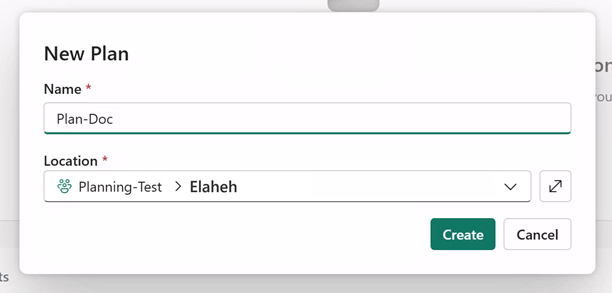
2. On **New Plan**, enter a name for your plan, and then select **Create**.
{% hint style="info" %}
### Note
When you create a plan item, you also automatically create a Fabric SQL database in your workspace. This database stores your plan report's metadata.
{% endhint %}
### Create your planning sheet
1. In your new plan item, you see options to get your data from the semantic model or from Excel, and to create a planning sheet from it. Alternatively, start with a planning sheet and then connect it to data.
2. Select **Planning**, enter a name for the new planning sheet, and then select **Create**.
### Add the semantic model connection
In this section, you add the semantic model connection that you created earlier (see the [Prerequisites](#prerequisites) section). The result of this step is that your planning sheet has access to data in the semantic model.
1. In your new planning sheet, select **Add**.
2. Under **Select a Connection**, connect to your semantic model connection.
{% hint style="info" %}
### Note
Only connections with the **Power BI Semantic Model** connection type that the current user has access to appear in this dropdown.
{% endhint %}
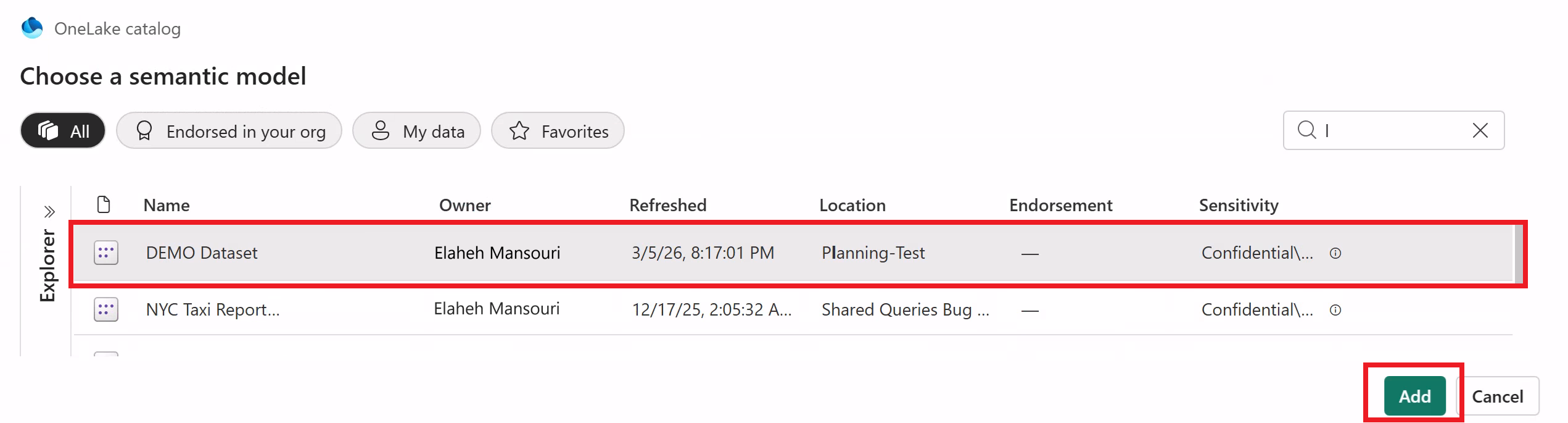
3. Select the semantic model, and then select **Add**.
4. Add semantic model data into your fields. Now you have your first planning sheet.
{% hint style="info" %}
### Note
Each Plan item is associated with a single semantic model. To connect to a different semantic model, [create a new Plan item](#create-plan-item).
You can create multiple Plan items within the same billing session. All items you create use the same active billing session, regardless of the number of items or use cases. For more information, see [Billing and usage for Fabric Planning](/resources/billing-in-fabric-plan.md).
{% endhint %}
### Optional: Connect to a database for collaboration
If you want to collaborate with others on this planning sheet, create a database connection for your plan item to store comments and other collaboration details. For more information, see [Create a database connection for collaboration](/get-started/create-a-database-connection-for-collaboration.md).
---
# Agent Instructions
This documentation is published with GitBook. GitBook is the documentation platform designed so that both humans and AI agents can read, navigate, and reason over technical content effectively. Learn more at gitbook.com.
## Querying This Documentation
If you need additional information that is not directly available in this page, you can query the documentation dynamically by asking a question.
Perform an HTTP GET request on the current page URL with the `ask` query parameter, and the optional `goal` query parameter:
```
GET https://docs.fabricplan.com/get-started/creating-a-planning-sheet.md?ask=&goal=
```
`ask` is the immediate question: it should be specific, self-contained, and written in natural language.
`goal` is optional and describes the broader end goal you are ultimately trying to accomplish on behalf of the user. GitBook uses it to tailor the answer towards what is most useful for that goal.
The response will contain a direct answer to the question and relevant excerpts and sources from the documentation.
Use this mechanism when the answer is not explicitly present in the current page, you need clarification or additional context, or you want to retrieve related documentation sections.